Showing posts with label South America. Show all posts

8.10.2009

The Streets of Salvador


We left Abracadabra before dawn with Salvador as our destination. The three kilometer hike to town was easier for us because we stashed some of our gear at the local cacao trader the day before. We were lucky to catch the bus, as it pulled up right as we were jogging down the last hill into Agua Fria. A few buses and a ferry later, we pulled into the bay of Salvador -- the only place in Brasil where the sun sets over the ocean. Truly a sight to behold!


Salvador is the home of capioera, the Brasilian martial art dance, and the seat of Afro-Brasilian culture. We watched a drum corps practice near our hostal one day, the children kept the complex Brasilian beats impressively well.


The main square mad a great venue for samba concerts. During our eight day stay, we saw live concerts every night. We heard someone say in passing that if there's no drinking and dancing in the streets, then you're not in Salvador. We found this to be quite true, and although we enjoyed hearing rythms late into the night, we decided to head to a quiet beach for a few days.


Only two hours north from Salvador by bus, we found a cute beach town called Arembepe. Za had joked on the way there that she wanted an individal cabina with a swimming pool right on the beach. We laughed at the unlikely prospect of this wish coming true, as our budget hadn't allowed for such luxuries on our trip. Sometimes though, you do get what you wish for!


We found an amazing cabina right on the beach complete with a mini refrigerator, swimming pool, and sun huts with lounge chairs. This is the view from our bed, truly wonderful.


Nearby our honeymoon suite was an old hippie village. Popularized by Mic Jagger and Janis Joplin several decades ago, artisians still sell crafts and live in huts in the tropical paradise. The artist's house above has seen thousands of visitors over the years.


Still honey mooning! :)


We had the beach virtually to ourselves. Sea turtles nest all around the coast, and we swam with one. Actually, Za ran out of the ocean the moment she saw it, but it was quite cute. Each night we walked into town to eat Bejous, a tapioca pancake with filling. Tasty and cheap!
After our R&R minivacation, we returned to Salvador to prepare for our journey to Europe.


7.05.2009

WWOOFing at Abracadabra

WWOOF:
Willing Workers On Organic Farms
or
World Wide Opportunities on Organic Farms

We heard about WWOOFing and knew we wanted to try it in Brazil because the cost of living is higher compared to the rest of South America. WWOOFers volunteer on a farm in exchange for room and board. The minimum stay and hours worked vary from farm to farm and are negotiated ahead of time.

We met a person at our Vipassana 10 Day meditation retreat from Itecaré Brazil who said the town had lots of sun, beautiful beaches, and friendly people. When we started looking for farms in Brazil we found one in Itecaré that had a cacao forest. Sounded like a great place to save some money and learn all about where chocolate comes from.

So after relaxing for 3 days in beautiful Itecaré, we took the local bus to Agua Fria, a small village 2 hours in from the coast. We then started our hour long hike up a muddy, hilly road to the farm.


The walk was supposed to be 3km, but with all our gear and all the hills, it seemed like a lot longer. The waist-strap on my main pack ripped halfway there probably because I was carrying too much weight in it. While still walking the sun set and we had to get out our flashlights to finish the walk. As we trudged along with our heavy gear and aching shoulders in unfamiliar and remote territory, our minds started to doubt our progress: "Shouldn't we be there by now? Did we pass it? Were we supposed to go left at the first fork instead of right?" .... we actually considered dumping our bags and sending one of us ahead as a scout to find the farm. But the mosquitoes came with sunset and neither of us wanted to quit moving.

We finally made it to the farm well past dark relieved and grateful for a warm welcome and meal.

The next day we got a better view of the beautiful land the farm was on and started learning about life on the farm...


The seven or so bedrooms in the house had mosquito nets. The front porch looked out on a big grassy yard. On the back side of the house near the kitchen, was the only running water on the farm - a sink fed from a natural spring - that was used to wash the dishes as well as fill the water filter for drinking and the large bucket behind the tarp used for showering.


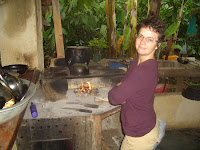
The kitchen was outdoors but covered by a roof. We usually made a fire and cooked on the woodstove, but there was also a gas stove for baking and heating some water for tea or coffee when we weren't already making a big meal. The dining area next to the kitchen also served as early mornning yoga studio, and mid-day lounge area. There was also a detached Dry Compost Toilet - dry meaning, go pee in the yard or the forest.


We often walked five minutes to this beautiful waterfall for a mid-day break or to rinse off after a hard day of work.


Probably 60 or 75% of our food was grown right on the farm, either in the large organic vegetable garden next to the house, or on the many fruit trees (banana, jackfruit, citrus, nuts and others).

Below are our friends Haraldo and Eyal - the owners, operators, and our gracious hosts at the farm.


Work on the farm varied from day to day, but was not usually more than 4 hours a day. The most fascinating part to me was helping with the CACAO (pronounced ca-cow), or chocolate harvesting. The cacao fruit grows to the size of a small football on trees that are 10 to 15 feet tall. The flowers form right on the bark anywhere along the trunk or branches in the shade of the leafy trees. The fruit starts out as dark green or dark purple and ripens to yellow, red or light green depending on the variety of cacao tree. The trees produce fruit year round but June and July are the big harvest times.


We collected large piles of ripe cacao fruit from the trees and ground. With all the fruits from an area of the forest collected, the fruits were opened with a machette and the seeds (the cacao beans) were dumped out or scraped out and collected. The seeds are covered in a white, juicy pulp.


The seeds from the freshly ripe cacao fruits were collected separately and the juice from them were collected to make a magical drink called cacao honey. The seeds are dumped in a mesh bag which is twisted and squeezed so that the juice in the pulp surrounding the seeds can be collected and drank - usually right there in the forest. After working and sweating for a couple hours in the forest, the awesomely sweet cacao honey was a great treat. I never imagined that the counter part to the bitter cacao bean was a deliciously sweet juice.


All the beans were carried back to the house and after being left to ferment for a few days, were dried on the roof, or when the weather was rainy a large wood-burning cacao dryer was used. Most of the dried beans were then taken by horse or mule into town and sold to the local cacao buyer. Of course a number of the beans were left at the farm for residents and volunteers to enjoy. We roasted the beans just long enough to make removing the light brown skins from the beans, leaving the dark bitter cacao bean. My favorite snack on the farm was to eat raw cacao beans interspersed with bites of fresh bananas. That reminds me, the large green stalks that the bananas grow on are not trees. The banana plant is actually a type of grass, a ginormous fruiting variety of grass - who knew? We also made some fresh chocolate by melting the beans along with fruits and sugar for sweet a great treat.


And after the harvest, hundreds of cacao shells are left to decompose and feed the following generations of cacao fruits.


In addition to our cacao work, we also worked in the organic vegetable garden, usually weeding and occasionally planting new vegetables as we did in the heart shaped plot shown below.


One day our job was to pull ticks off one of the horses. A thoroughly disgusting job that was rewarded with a pleasant ride on the horses around some of the farm land.


One afternoon I got to sharpen my engineering skills (and save my fingers) by planning out and carving a doorknob for the door to our room. The door closed snuggly even without hardware, but our fingers were getting scratched up reaching in the hole to open and close the door.


We also planted trees one morning, to help reforest the land. The local tradition has been to burn large fields and forest area to clear the trees and/or grasses and plant a monoculture. So one of the main goals of the farm is to reforest the land and add diversity to support the local ecosystem.
Four of us planted 10 trees one morning and it was suprisingly quite a bit of hard work.


Only working 4 hours a day, there was also plenty of time to party and celebrate. We helped the local live-in family (who are doing construction and most of the cacao harvest) celebrate Gabby's 3rd birthday. A great homemade cake and the classic game of hitting baloons in the air trying not to let any hit the ground made for a great evening.


Speaking of the local family, 2 year old Kaike is shown below with one of his favorite toys - a machette. If he didn't have a machette in his hand, he usually had a steak knife as his other favorite toy. We thought we should take them away at first, but the sooner you learn to be skillful with a blade in this remote environment, the better.
After practicing with a machette (cutting grass and sweating profusely) for 30 minutes, I later watched Keike's father, chop an area of grass much larger than mine in only 5 minutes.


Overall, life at the farm was simple, hard, and extremely fulfilling. After traveling, vacationing, and being a typical tourist for 3.5 months, it was really nice to do some work to contribute to something and get a sense of satisfaction and accomplishment. It was also satisfying to get up and go to sleep with the sun (a necessary adaptation when there is no electricity). It was nice to be able to work and take a break to read some books or go to the waterfall and then work some more. It was also easy to see the value in the work we did - rather than sitting inside all day to earn money to buy food, a lot of our work was simply taking care of the garden and eating from it. Some of the books I read at the farm were manuals about earthen architecture - we hope to grow our own food and build a cob house (mud and straw) when we return home. WWOOFING was great for our pocketbook and great for our spirits. We're looking forward to our next WWOOFing vacation from vacationing!


Above is the river in a nearby village, where we sold cacao, bought some rice and beans, and checked internet.

6.30.2009

Carioca in Rio


From Wikipedia:
Carioca" is a Portuguese adjective that refers to the city of Rio de Janeiro, Brazil. The original word "Kara'i oca" comes from the indigenous Amerindian language of the Tupi people, meaning "White Man's House".

According to a survey published in American Scientist Magazine, the Cariocas of Rio de Janeiro exhibited great friendliness and offered to help in various situations. A quote from the article mentioned the following:

There is an important word in Brazil: simpático. (Actually it's a Greek origin word meaning sym-pathy that you feel very concerned (almost the same) about someone else's suffering). It refers to a range of desirable social qualities - to be friendly, nice, agreeable, and good-natured. A person who is fun to be with and pleasant to deal with .... Brazilians, especially the Cariocas of Rio (as citizens here are known), want very much to be seen as simpático. And going out of one's way to assist strangers is part of this image.


Our time in Rio was short, but we did have a few days to witness the Carioca lifestyle and all the culture and music that makes Rio such a great city.


We went to Ipanema beach to look for the Girl from Ipanema, but we didn't find her. We had a great yoga session instead.


We took a day trip to the Modern Art Museum. This impressive structure was designed by Oscar Niemayer, an amazing architect. He has many structures throughout Brasil and the world.


We went out with some couchsurfing friends one night, and discovered that the sidewalks are called "Brasilian rugs". The black and white stone work adornes most city blocks, and although it's nice to look at, the women hate it because it's dangerous to walk on with high heels!


Christ the Redemer statue is visibile throughtout the city. What a beautiful landmark! Our hostal was also a highlight during our visit in Rio, and we wish we could have spent more time getting to know people. We had to press on, however, to volunteer up the coast. . .

6.06.2009

The Indra Devi Foundation - yoga for the people


Indra Devi was born in 1899 in Riga, Latvia. She was fascinated with India and moved there in 1927 to dance and act in the film industry. She found yoga in 1937 and trained with Sri Tirumalai Krishnamacharya, a Yoga master whose other students included B.K.S. Iyengar and K. Pattabhi Jois. Often referred to as the first lady of yoga, Indra Devi brought the practice to Soviet Russia, China, Vietnam, South Africa and eventually Mexico and Argentina. She moved to Buenos Aires in 1982 and set up the Indra Devi Foundation : Yoga, Art and Science of Life.


She dedicated her life to bringing yoga to all people. At age 100, she was still practicing Ardha Sirsasana, Janu Sirsasana, Ardha Matsyendrasana, and Padmasana. She died just shy of her 103rd birthday in Buenos Aires. Her students refer to her as Mataji, a rare honor for a woman who exemplifies Yoga´s principles.


When we arrived in Buenos Aires, we picked the studio closest to our hostal to go make some contacts. Luckily, we met the two individuals who run the foundation and teach throughout the city. David and his wife Iana welcomed us with open hearts and arms. We signed up for classes and started to work on our Spanish anatomy right away. Our teachers and their youth class are pictured below.


We attended classes at four of the six locations throughout our stay. Each location is beautifully decorated with artwork and fotos from decades of yoga lineage. There is a room in one of the studios that holds many of Indra Devi´s favorite things from her life.


The class structure is quite different than that of an American yoga class. The pace is slower and more relaxed. There is not as much a sense of competition. Each class started with chanting Ohm, followed by neck warm-ups. The classes were primarily asanas, but also included pranayama, mantras and mudras dispursed throughout the class. Class was usually followed by a short dharma talk or a candle light concentration/meditation. The pranayamas were simple but effective. Just when I thought the asanas were getting too hard and I was exhausted, our teacher would have us do a simple short pranayama that would quickly relieve the stress in my body and calm my mind.

The students were of all kinds - skinny and large, short and tall, young and old, new and advanced, pregnant and not. The sun salutations were slower paced and started and ended in child´s posture. But in some ways, they were harder, like transitioning from downdog to updog in a flow while bending your arms and lowering your head rather than just lowering the hips and keeping the head high.
Most asanas were taught with 2 or 3 difficulty levels and each version was demonstrated starting with the easiest. I think it is nice for a beginning student or less advanced student to see the easy version demonstrated first as opposed to demonstrating a hard posture and then explaining in words how to make it easier. This may be one way that the Indra Devi schools keep a wide range of students coming back to class. The classes were challenging for all students regardless of their flexibility and strength.
Every class ended with "Ohm signifies love and Shanti signifies peace. Ohm shanti." And then every or almost every student hugged and kissed the teacher and other students with the greeting "Ohm shanti". It was an akward experience the first day of class as rarely do students hug their yoga teacher in the US, let alone hug and kiss everyone in the room. But it was a nice experience that really helped to strengthen the sense of community and family among the class.


David invited us to several activities, including a six mile walk around a rose garden and breakfast on a relaxed Sunday. He gave us rides home several times and this gave us an opportunity to ask questions about Mataji´s life and his experiences with her over twenty plus years. We enjoyed our time at the Indra Devi studios and hope to bring more yogis from the US to study for years to come.
Om Shanti!